Awards · AU
Wet weather provisions in construction awards
Last updated 1 October 2026
How paid wet weather works under Australian construction awards, including the 32-hour credit, payroll records and common traps.
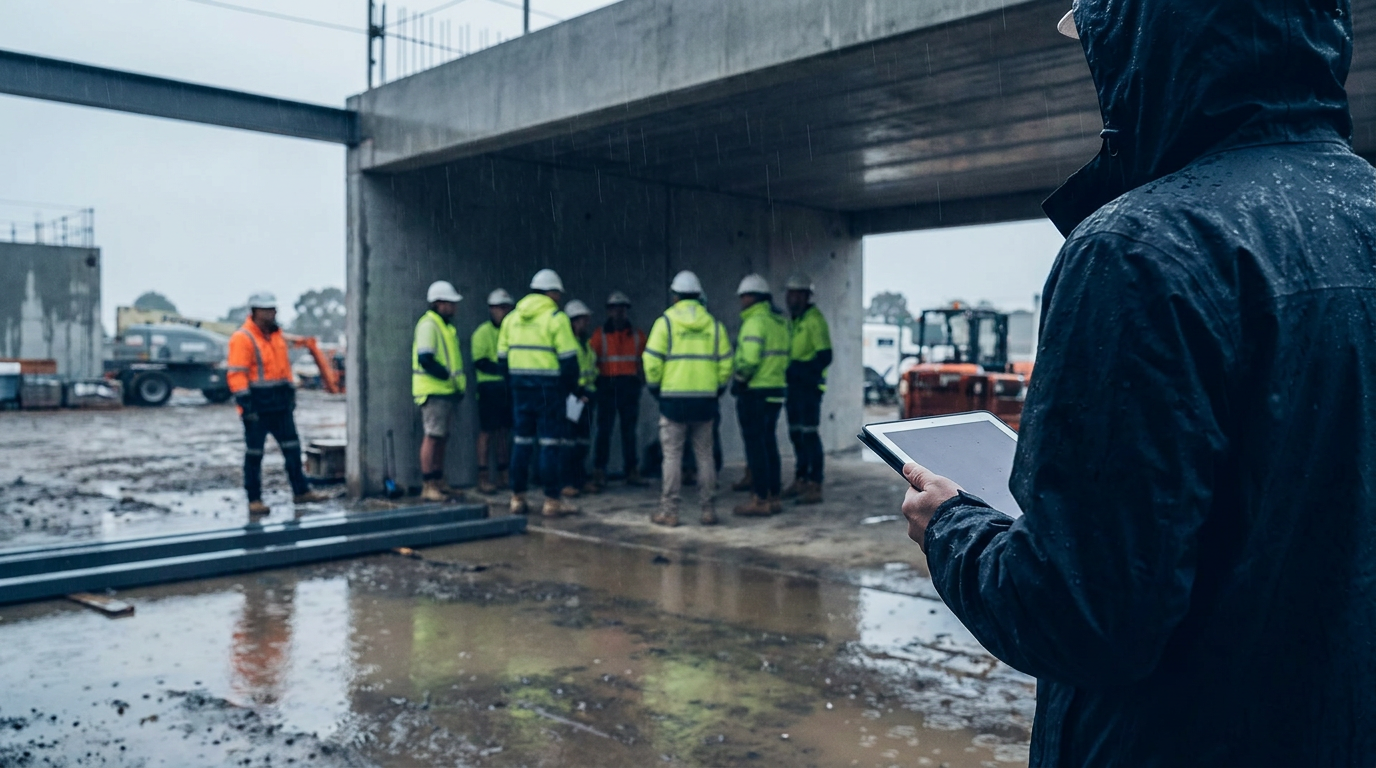
Under Australia’s main on-site construction award, workers who lose ordinary hours because inclement weather stops work are generally paid at their ordinary hourly rate, using a credit of up to 32 hours in each 4-week period.
That sounds simple. In payroll, it can get messy. You need the right award, the correct hourly rate, an accurate wet weather balance and records showing why work stopped.
What counts as wet weather?
The Building and Construction General On-site Award 2020 uses the broader term “inclement weather”. It is not limited to rain.
Inclement weather can include rain, hail, extreme cold, high wind, severe dust storms, extreme heat or similar conditions. The key question is whether it is unreasonable or unsafe for employees exposed to those conditions to continue working.
A shower does not automatically mean everyone goes home on pay. The conditions must prevent the employee from safely or reasonably performing their work.
The effect can also vary around the site. A crane crew may have to stop because of high winds while employees working safely inside continue. After rain, excavation or roofing work may remain unsafe even though the sky has cleared.
The employer should confer with affected employees, or their representative, about whether work can continue. A weather app is useful evidence, but it does not make the decision by itself.
The main numbers payroll needs
For employees covered by the Building and Construction General On-site Award, the paid inclement weather credit is the starting point.
As at October 2026:
- Up to 32 ordinary hours may be paid for time lost to inclement weather in each 4-week period.
- The employee’s accumulated credit is capped at 32 hours. It is not an unlimited bank of paid leave.
- Award minimum rates applying from the first full pay period starting on or after 1 July 2026 must be used when calculating the employee’s ordinary hourly rate.
- Payroll and time records generally need to be kept for 7 years.
- A payslip must generally be issued within 1 working day of payday.
The 32-hour credit deals with ordinary working time lost. It does not guarantee payment for overtime that an employee expected to work.
If you are checking classifications and current rates, use the award rate checker. Our construction awards hub also explains how classifications, allowances and penalty rates fit together.
How the credit works
Think of the credit as a payroll balance, not personal leave.
When ordinary time is lost because qualifying inclement weather stops work, the lost hours are deducted from the employee’s available credit. Payroll pays those hours at the ordinary hourly rate required by the award.
Unused hours may carry into the next 4-week period, but the balance cannot grow beyond 32 hours. You therefore need a defined cycle for each employee or work group. Do not treat the cycle as a calendar month. Four weeks and one calendar month are not the same thing.
For example, say an employee has a 32-hour balance. They are sent home after working 3 hours of a rostered 7.6-hour day. If the remaining time qualifies, payroll records 3 hours worked and 4.6 paid inclement weather hours. Their balance falls to 27.4 hours.
If another 30 ordinary hours are later lost before the credit refreshes, only the available 27.4 hours are payable under this provision. Before withholding the remainder, check whether an enterprise agreement, employment contract or site arrangement provides something more generous.
Common situations and payroll treatment
| Situation | Usual treatment under the Building Award | Wet weather credit used? |
|---|---|---|
| Employee keeps doing normal work safely | Pay hours worked in the usual way | No |
| Employee moves to suitable alternative duties | Pay hours worked under the applicable award rules | No |
| Employer sends the employee home during ordinary hours because work cannot continue | Pay qualifying ordinary time lost, subject to the available balance | Yes |
| Planned overtime is cancelled before it starts | No inclement weather payment for the unworked overtime | No |
| Rain falls on a rostered day off | No ordinary hours were lost | No |
| Employee is absent without reasonable cause immediately before or after the stoppage | Entitlement may be affected, so check the award facts before paying | Possibly |
Alternative duties might include protected work elsewhere on the site, clean-up tasks, maintenance, training or work at another location. The work still needs to be safe, suitable and allowed by the employee’s classification.
Do not debit the balance merely because it rained. Debit it only when the employee loses qualifying ordinary hours and receives inclement weather payment.
Which hourly rate should be paid?
The award refers to the employee’s ordinary hourly rate. That may be more than the bare classification rate.
Some award allowances are all-purpose. When an allowance is all-purpose, it forms part of the rate used for certain award calculations. Other reimbursements or expense-related allowances do not.
Check these items before processing the payment:
- The employee’s award and classification.
- The minimum rate applying from the correct full pay period.
- Any applicable all-purpose allowances.
- Whether an enterprise agreement sets a higher rate or different wet weather rule.
- Whether the lost time was ordinary time rather than overtime.
Avoid coding the payment as annual leave, personal leave or unpaid leave. Inclement weather credit is a separate award entitlement. A clear pay code such as “paid inclement weather” makes the payslip and audit trail easier to follow.
Not every construction worker has the same rule
The Building and Construction General On-site Award covers many workers performing on-site building, civil construction and general construction work. It does not cover every person who steps onto a construction site.
Electricians, plumbers, fire sprinkler fitters, manufacturing employees, security workers and office staff may be covered by different awards. Those awards can have different definitions, payment rules and consultation requirements.
An enterprise agreement can also contain its own inclement weather clause. If it applies, payroll should follow that instrument rather than automatically importing the Building Award’s 32-hour system.
Classification comes first. Site custom comes second. “That is how this project has always done it” is not enough if the applicable award or agreement says otherwise.
Records that make wet weather payroll defensible
Keep enough information to show what happened. A simple record should include:
- the date and site;
- when the weather or unsafe condition started and ended;
- which work areas and employees were affected;
- ordinary hours worked before the stoppage;
- alternative duties offered or performed;
- the time employees were directed to leave;
- paid inclement weather hours;
- each employee’s opening and closing credit; and
- who authorised the decision.
Site diaries, supervisor notes, time records and weather observations should agree. If one system says the worker left at 11:00am and another says 1:30pm, payroll should clear that up before finalising the pay run.
Mistakes worth avoiding
The first common mistake is paying everyone whenever rain appears on the radar. The second is the opposite, sending workers home without checking whether paid inclement weather credit applies.
Other traps include using a monthly balance instead of a 4-week cycle, deducting annual leave without agreement, paying only the base classification rate, and letting the credit accumulate beyond 32 hours.
Also watch for blanket site declarations. Conditions may stop external work without affecting protected areas. Record the decision by crew, task or location where necessary.
A clean process is straightforward. Confirm coverage, assess whether the conditions prevent work, look for safe alternative duties, record the direction, then pay qualifying lost ordinary hours from the available credit.
The Pay Run newsletter
Join the list, payroll for builders, explained fortnightly.
One email. Unsubscribe anytime. We never share your details.
Questions
Do construction workers get paid when rain stops work?
Often, yes. Under the Building and Construction General On-site Award, qualifying ordinary hours lost because of inclement weather are paid at the ordinary hourly rate, subject to the employee’s available 32-hour credit. Different awards or enterprise agreements may apply.
Does light rain automatically trigger wet weather pay?
No. The rain or other conditions must make it unreasonable or unsafe for the affected employee to continue working. The employer should also consider whether safe, suitable alternative work is available.
Can an employer make workers use annual leave for a wet weather day?
An employer should not automatically deduct annual leave. If the award’s inclement weather provision applies and the employee has credit available, that provision should be considered first. Annual leave generally requires a lawful direction or agreement.
Are cancelled overtime hours covered by the 32-hour credit?
Generally, no. The Building Award provision covers ordinary time lost. It does not usually pay overtime that was planned but not worked.
Does unused wet weather credit get paid out when employment ends?
The credit is not the same as accrued annual leave and is generally not treated as a cashable leave balance. Check the applicable award or enterprise agreement before processing a termination, particularly if it contains more generous terms.
What if an enterprise agreement has different wet weather rules?
Follow the enterprise agreement if it legally applies to the employee. It may provide a different hour bank, a site-specific procedure or more generous payment. Keep the applicable clause with the payroll setup and site records.
Construction payroll
Stop reading about it. Put it on your crew.
Published pricing, so you never need a call to get a number. We read your award or agreement and build it, and a walkthrough is there whenever you want one. We reply within one business day.
15 minutes, your EBA, no sales script.
No lock-in · Published pricing · We reply within one business day