Awards · AU
Building and Construction Award MA000020 explained
Last updated 6 September 2026
Current guide to MA000020 coverage, pay, overtime, RDOs, allowances, inclement weather, casuals and records as at September 2026.
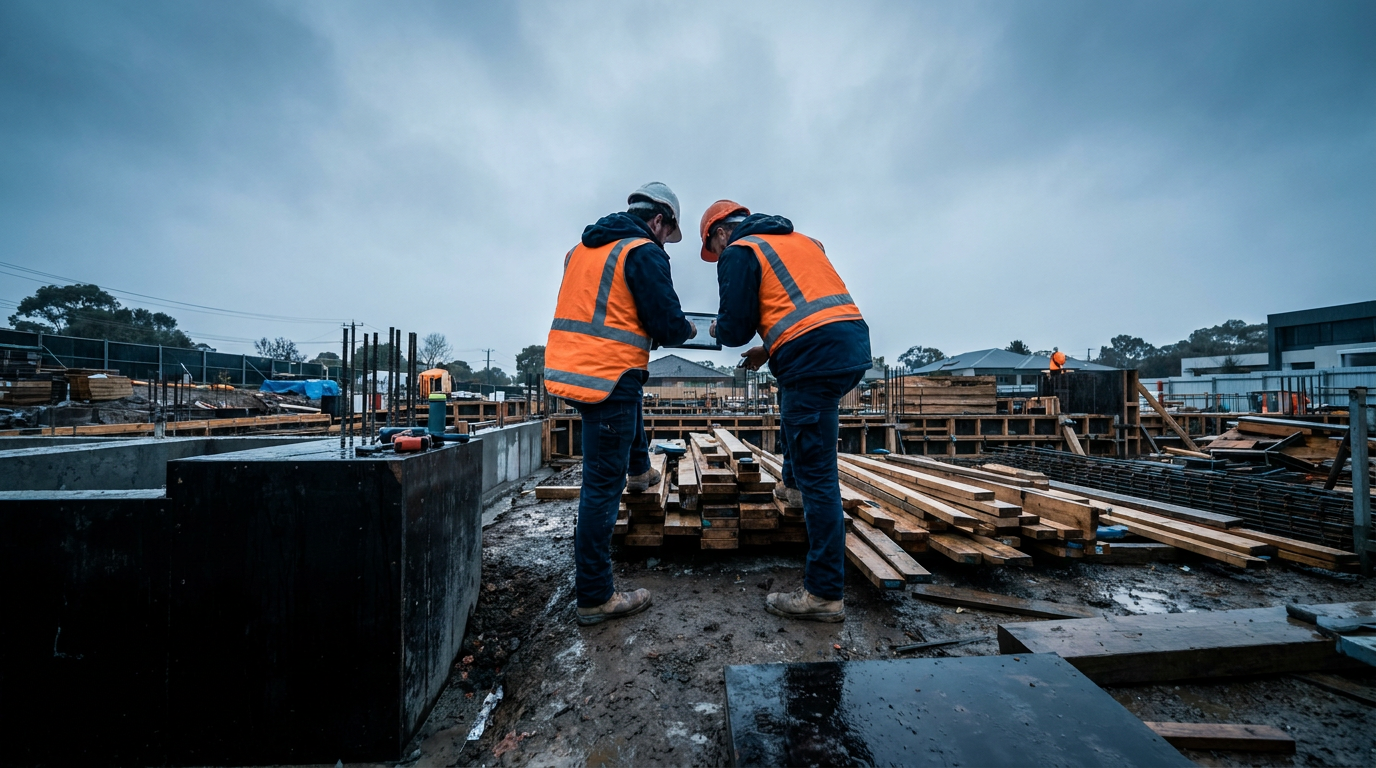
The Building and Construction General On-site Award 2020, MA000020, sets minimum pay and conditions for many Australian on-site construction workers. It covers classifications, ordinary hours, overtime, allowances, RDOs, travel, inclement weather and industry-specific redundancy.
Who does MA000020 cover?
The award generally covers employers and employees performing on-site building, civil and engineering construction work. Common examples include labourers, carpenters, bricklayers, concreters, plant operators and employees carrying out civil construction.
Coverage is not decided by a worker's job title alone. You need to check:
- The employer's industry.
- The work the employee actually performs.
- Whether a classification in the award describes that work.
- Whether another award or an enterprise agreement applies instead.
Some workers on the same project may be covered by different awards. Electricians, plumbers, clerical staff and manufacturing employees can fall under other instruments. Independent contractors are not award employees, but calling someone a contractor does not make it so. The real working arrangement matters.
You can find related construction award guides in our Awards hub.
Key figures to know
As at September 2026, the standard award week is 38 ordinary hours, casual loading is 25%, and the super guarantee rate is 12% of ordinary time earnings.
Also as at September 2026, eligible permanent employees receive 4 weeks of annual leave, with award annual leave loading generally calculated at 17.5%. The award's paid inclement weather limit is 32 hours in a 4-week period, subject to the award conditions.
These percentages do not tell you the employee's final dollar rate. The rate depends on classification, employment type, age or apprenticeship stage, and any all-purpose allowances.
As at September 2026, minimum award wages are set by the current award pay schedules. Annual wage review changes generally apply from the first full pay period starting on or after the operative date stated in the relevant award determination. Check the employee's pay cycle against that operative date before applying a new rate.
Use the current award rate checker rather than copying a rate from an old payslip, tender or employment contract.
Ordinary hours, RDOs and overtime
A common award arrangement uses a 20-day, 4-week cycle. Employees work 8 hours on 19 days, with 0.4 hours from each day accruing towards a paid rostered day off. That produces 152 ordinary hours over the cycle.
Do not assume every construction employee has the same RDO calendar. The award allows particular arrangements, and an enterprise agreement may set a different cycle. Payroll should follow the roster and instrument that actually applies.
For non-casual dayworkers, the following table shows common award settings as at September 2026. Shiftwork and casual overtime can produce different calculations.
| Pay item | Common award setting | Payroll treatment |
|---|---|---|
| Ordinary hours | 38 hours a week | Pay at the applicable classification rate, including relevant all-purpose components |
| RDO accrual | Commonly 0.4 hours per worked day | Track accrual and paid RDOs separately |
| Monday to Friday overtime | 150% for the first 2 hours, then 200% | Apply the rate to the correct overtime base |
| Saturday overtime | 150% for the first 2 hours, then 200% | Work after noon is generally paid at 200% |
| Sunday work | 200% | Check minimum payment and call-out rules |
| Public holiday work | 250% | Check the award and NES public holiday rules |
| Casual loading | 25% | Casual overtime must follow the award's casual calculation, not simply a permanent rate |
An employee cannot usually work ordinary hours all week and then have extra site hours treated as ordinary time. Daily and weekly overtime triggers both matter. Keep actual start times, finish times, breaks and RDO activity.
Classifications come before rates
MA000020 uses construction worker and engineering construction worker classification levels, often shown as CW or ECW levels. The correct level depends on duties, skills, qualifications, responsibility and the equipment operated.
A worker who holds a trade qualification is not automatically paid the same as every other qualified worker. You still need to read the classification definitions. Leading hand duties, supervision, specialised plant and additional responsibilities can change the result.
Apprentice rates require another check. They can depend on:
- the apprenticeship year or competency stage
- whether the apprentice is an adult apprentice
- when the apprenticeship started
- schooling completed before the apprenticeship
- the relevant trade classification
Do not leave an apprentice on the same percentage merely because your payroll record still says “Year 1”. Update the stage when the apprenticeship progresses.
Allowances are where mistakes pile up
Construction payroll rarely stops at the minimum hourly rate. MA000020 contains allowances connected with the industry, location, duties and costs incurred by the worker.
Depending on the facts, these may include:
- industry allowance
- fares and travel pattern allowance
- tools or protective clothing
- leading hand allowance
- first aid duties
- meal allowance for qualifying overtime
- distant work and travel expenses
- height, confined space, underground or unusually dirty work allowances
Some allowances are all-purpose. That means they become part of the rate used for calculations such as overtime or paid leave. Other allowances are expense-related and are paid only when the stated trigger occurs.
This distinction matters. Adding every allowance after overtime has been calculated can underpay an employee. Including every expense allowance in the overtime base can overpay them. Give each payroll item a rule, trigger and calculation basis.
Inclement weather is not ordinary downtime
The award has detailed rules for rain, extreme heat and other unsafe weather conditions. As at September 2026, the paid inclement weather entitlement is capped at 32 hours in a 4-week period.
That does not mean every site closure automatically uses the allowance. The award deals with matters such as reporting for work, remaining available, transferring to reasonable alternative work and returning when conditions improve.
Record the date, lost hours, site, reason, available alternative duties and remaining entitlement. A note saying “rain day” is rarely enough to reconstruct the payment later.
Daily hire, casual employment and redundancy
Daily hire is a recognised construction arrangement. A daily hire employee is not automatically a casual. They can receive paid leave and other permanent employee entitlements, even though the award contains particular termination rules for daily hire.
A genuine casual receives the 25% casual loading as at September 2026. Casuals do not receive paid annual leave or paid personal leave, but they may have conversion rights under the Fair Work Act.
The award also contains an industry-specific redundancy scheme. Do not automatically apply the standard National Employment Standards redundancy table. Check the award scheme, service history and any payments made into an approved redundancy fund.
A practical payroll check
For each worker, keep a written record of the applicable instrument, classification, employment category and allowances. Match timesheets against the roster before calculating overtime.
Payroll records must generally be kept for 7 years as at September 2026. They should show hours, rates, loadings, allowances, leave, super and deductions clearly enough to explain each payment.
Finally, check rates after every annual wage review, apprenticeship progression and role change. A correct rate can become wrong without anyone changing the employee's job title.
The Pay Run newsletter
Join the list, payroll for builders, explained fortnightly.
One email. Unsubscribe anytime. We never share your details.
Questions
Does MA000020 cover everyone working on a construction site?
No. Coverage depends on the employer's industry and the employee's actual duties. Electricians, plumbers, office staff and off-site manufacturing workers may be covered by another award or instrument.
Are daily hire construction workers casual employees?
Not necessarily. Daily hire is an award employment arrangement and can apply to non-casual employees. A daily hire worker may still receive paid leave and other permanent employee entitlements.
How do I find the correct MA000020 pay rate?
Identify the employee's classification, employment category and apprentice status first. Then use the rate applying from the first full pay period on or after the latest operative date. Add applicable all-purpose allowances before calculating overtime where required.
Do construction workers receive an RDO every four weeks?
Many employees work a 20-day, 4-week cycle and accrue 0.4 hours on each of 19 worked days for an RDO. However, the actual arrangement can differ under the award, a roster or an enterprise agreement.
Is travel from home to the construction site paid?
The award may require a fares and travel pattern allowance, but ordinary commuting time is not always paid working time. Distant work, employer-provided transport and travel between sites have separate rules. Check the facts against the relevant clauses.
Construction payroll
Stop reading about it. Put it on your crew.
Published pricing, so you never need a call to get a number. We read your award or agreement and build it, and a walkthrough is there whenever you want one. We reply within one business day.
15 minutes, your EBA, no sales script.
No lock-in · Published pricing · We reply within one business day