Awards · AU
Site allowances by project value: new-build, renovation and heritage work
Last updated 14 November 2026
By Project Payroll team
How Building Award site allowances differ for new-build, renovation and heritage projects, including project value checks and payroll treatment.
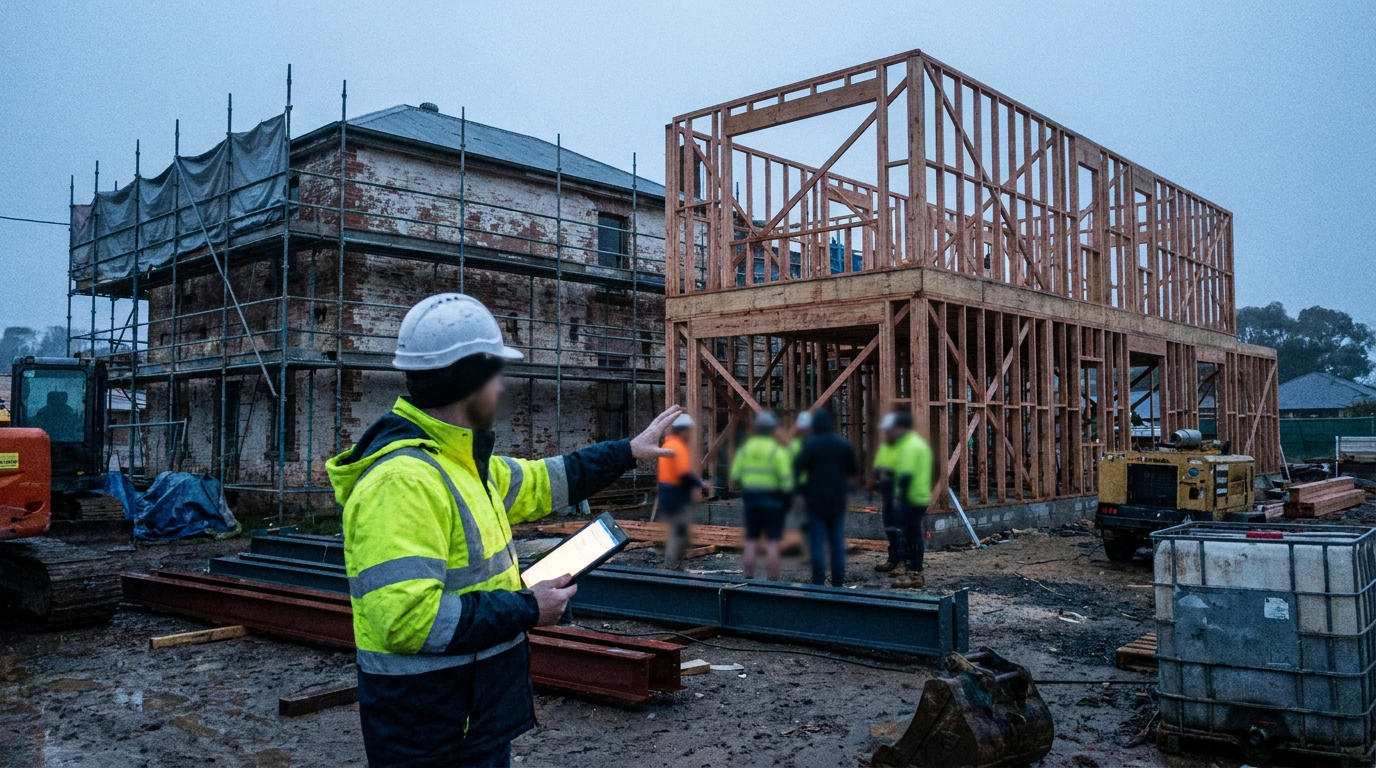
Under the Building Award, site allowance depends on project type and the indexed project value. New-builds use value bands, while qualifying renovations and heritage work use separate triggers. Check the operative 1 July 2026 schedule before paying.
Start with the right industrial instrument
When someone says, “This is a $20 million job, so what site allowance applies?”, do not jump straight to a rate table.
First confirm which industrial instrument covers the employee. For many workers, that will be the Building and Construction General On-site Award 2020, commonly called the Building Award. An enterprise agreement may instead contain its own site allowance table, definitions and project values.
The Award is the starting point only when it actually covers the employer and employee. Classification matters too. A carpenter, labourer, plant operator and electrical worker may not all sit under the same award.
You can read more about construction wage obligations in our Awards hub. Use the award rate checker to confirm the applicable classification and current minimum rate.
New-builds use project value bands
For new construction, the Building Award’s site allowance structure works by matching the project’s construction value to an indexed band. Higher-value bands attract higher hourly allowances.
Think of it like this. Your mate tells you the contract is worth $18 million. That number alone is not enough. You need to know:
- Whether it is the value used under the Award’s definition.
- Whether the job is new construction, renovation or heritage work.
- Which indexed value band applies when the work is performed.
- Which hourly allowance corresponds to that band.
- Whether an enterprise agreement has replaced the Award rule.
Do not use the property’s eventual sale value. Do not automatically include the land value. Do not rely on a rounded figure from a tender announcement. Keep written confirmation of the relevant construction value from the contract administrator, quantity surveyor or another authorised project contact.
The dollar thresholds and hourly rates are adjusted over time. For payroll in November 2026, use the schedule operative from 1 July 2026. Do not copy a 2025 rate from an old spreadsheet.
Renovations do not always follow the new-build bands
Renovation and refurbishment work has its own treatment. A large renovation is not automatically processed as if it were a new tower of the same contract value.
The Award separates additions, renovations and refurbishment of an existing building from qualifying new construction. The renovation provision uses its own project value trigger and rate mechanism. Payroll needs the work description, not just the contract total.
A mixed project can be tricky. For example, a builder might retain an existing façade, refurbish three floors and add a new structure behind it. Ask how the project is described in the contract and how the construction work is divided. If the answer is unclear, get industrial advice before choosing a category.
Calling every existing-building job a renovation can also cause trouble. Demolition followed by an entirely new building may be new construction. A substantial extension may need closer examination under the Award wording.
Heritage work has a separate test
An old building is not necessarily a heritage building.
For the heritage category, confirm that the building or site has the recognition required by the Award. Age, appearance or a developer’s description is not enough. Keep evidence of the relevant heritage listing or status with the project record.
The heritage provision also has an indexed project value trigger. Once the Award conditions are met, use the current heritage allowance rather than choosing a new-build band because the overall development is expensive.
Heritage projects often contain several scopes. One crew may restore listed masonry while another works on a new adjoining structure. Record where employees worked and what work they performed. A single project code may not provide enough detail for payroll.
Comparing the three categories
| Project category | Main payroll test | How the allowance is selected | Evidence to keep |
|---|---|---|---|
| New-build | Is it qualifying new construction, and what is the Award project value? | Match the value to the current indexed band | Contract scope, confirmed construction value, applicable Award table |
| Renovation or refurbishment | Is work being performed on an existing building, and is the separate value trigger met? | Apply the current renovation provision | Scope of works, value confirmation, dates and employee location |
| Heritage work | Does the building or site have the heritage status required by the Award, and is the trigger met? | Apply the current heritage provision | Heritage record, contract scope, project value and work allocation |
Figures payroll should lock down
Several payroll settings sit beside the site allowance calculation.
As at November 2026, the standard full-time ordinary week under the Building Award is 38 hours, subject to the Award’s rostering and averaging rules.
As at November 2026, common weekday overtime for a day worker is 150% for the first 2 hours and 200% after that, although the employee’s work pattern and the particular overtime clause must be checked.
As at November 2026, the standard casual loading is 25% for covered casual employees, subject to the Award’s rules about what that loading compensates for.
As at November 2026, payroll should be using rates effective from 1 July 2026, not the rates that applied before the annual wage review change.
These figures do not replace the site allowance table. They matter because an allowance can affect other calculations if the Award identifies it as all-purpose. Check the allowance description before deciding whether it belongs in the base used for overtime, penalties, leave or superannuation.
Do not hard-code project bands forever
Project value thresholds and allowance amounts can be indexed. A project that sat near a boundary when it commenced needs careful handling after a rate update.
Set each project up with these fields:
- industrial instrument
- project category
- confirmed project value
- source and date of that value
- applicable value band or trigger
- current hourly allowance
- effective date
- heritage status, where relevant
- enterprise agreement coverage, if any
Use effective-dated payroll rules. Do not overwrite the old rate when a new rate starts. You may need the previous rate for corrections, back pay and audit work.
A practical payroll check
Before the first pay run, ask the project manager five short questions:
- Is this new construction, renovation, refurbishment or heritage work?
- What construction value should be used under the Award definition?
- Who confirmed that value?
- Is any part of the work covered by an enterprise agreement?
- Are employees moving between different project areas or sites?
Then test one employee manually. Check ordinary hours, site allowance hours, overtime, penalties, casual loading and superannuation treatment. Compare the manual result with payroll before processing the full crew.
That small check is much easier than fixing six months of underpayments after someone discovers the project was put in the wrong category.
The Pay Run newsletter
Join the list, payroll for builders, explained fortnightly.
One email. Unsubscribe anytime. We never share your details.
Questions
Is the site allowance based on the whole development value?
Not automatically. Use the project value described by the applicable Award provision or enterprise agreement. Do not substitute land value, expected sale value or a rounded public estimate. Obtain written confirmation of the relevant construction value.
Does a renovation use the same rate bands as a new-build?
Not necessarily. The Building Award separates qualifying new construction from additions, renovations and refurbishment of existing buildings. Identify the project category before selecting the current indexed rate.
Does every old building qualify for the heritage allowance?
No. The building or site must have the heritage recognition required by the Award. Keep evidence of that status. Age, architectural style or an informal description as a heritage building is not enough.
What happens when a worker moves between a heritage area and a new-build area?
Keep time and location records that show where the employee worked. The correct treatment depends on the Award wording, project structure and work performed. Get advice where the scopes cannot be separated cleanly.
Should site allowance be included when calculating overtime?
Check whether the applicable Award or enterprise agreement makes the allowance all-purpose. If it does, it generally forms part of the rate used for specified calculations. Do not assume every allowance receives the same treatment.
When should site allowance rates be updated?
Review them whenever the Fair Work Commission changes Award rates or indexed project values. For November 2026 payroll, check the schedule effective from 1 July 2026 and retain the previous rates for historical adjustments.
Construction payroll
Stop reading about it. Put it on your crew.
Crew Time sends approved site timesheets to Employment Hero. Ask about construction setup and award or EBA rebuild consulting, or book a walkthrough.
15 minutes, your EBA, no sales script.
No lock-in · Published pricing · We reply within one business day